

In the demanding world of structural engineering, the member selected for a primary load path carries consequences far beyond its purchase price. Bridges, long-span roofs, offshore topsides, crane booms and heavy machinery frames all rely on hollow sections that must deliver predictable strength, ductility and toughness under variable loading. For European-specification projects, EN 10210 S355J2H structural seamless steel pipe is one of the most frequently specified materials, and with good reason.
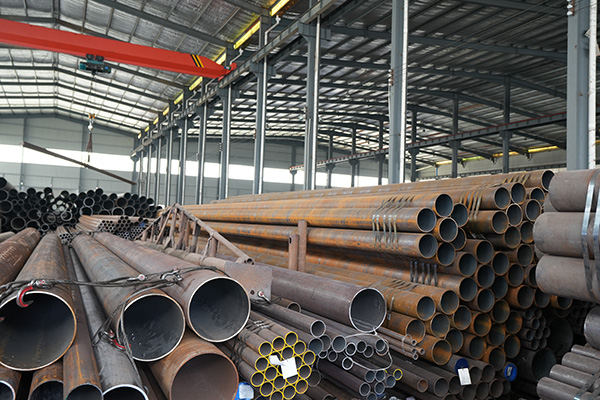
The global construction and infrastructure sector continues to push toward lighter, more efficient structures with longer spans and higher load ratings. Higher strength hollow sections contribute directly to that goal by reducing member size and total steel weight while maintaining the closed-section torsional and compressive efficiency that hollow profiles provide.
What S355J2H Actually Guarantees
The designation carries precise meaning under EN 10210, which covers hot finished structural hollow sections of non-alloy and fine grain steels:
S - structural steel
355 - minimum yield strength of 355 MPa for wall thickness up to 16 mm
J2 - minimum Charpy V-notch impact energy of 27 J at -20 C
H - hollow section
Tensile strength typically falls in the 470-630 MPa range, with good elongation and controlled carbon equivalent to keep welding straightforward. EN 10210 also specifies delivery condition - normally hot finished - and defines the inspection and testing regime. Where seamless rather than welded construction is specified, the pipe is produced by hot piercing and rolling or by cold finishing, giving uniform properties around the full circumference and no seam to inspect.
Why the -20 C Toughness Rating Matters
Structures in temperate climates routinely experience sub-zero conditions, and brittle fracture risk rises sharply as temperature falls. The J2 impact requirement is what separates S355J2H from the JR variant: JR is verified at +20 C and is unsuitable for exposed structures in cold regions. For bridges, offshore structures, crane structures and any member subject to dynamic or fatigue loading, the J2 rating provides a documented margin against brittle behaviour that designers and certifying authorities expect.
Advantages of Seamless Hollow Sections
Uniform strength around the circumference, with no seam heat-affected zone
Superior performance under fatigue loading, where welded seams can be initiation sites
Reliable behaviour in bending, whether cold bending for architectural curvature or hot induction bending for structural nodes
Predictable compressive and torsional behaviour thanks to consistent wall thickness and concentricity
Simplified inspection, since no longitudinal seam requires non-destructive examination
Typical Applications
Bridge structures, truss members and arch ribs
Long-span roof structures, stadiums and airport terminal buildings
Offshore platform topsides, jacket braces and flare structures
Crane booms, heavy lifting equipment and mining machinery frames
Transmission towers, sign gantries and communication masts
Architectural exposed steelwork where surface quality and uniformity are visible
Fabrication Guidance
S355J2H is readily welded by standard processes - SMAW, GMAW, FCAW and SAW - using consumables matched to the 355 MPa strength level. Standard good practice applies: controlled preheat for thicker sections, restricted heat input in accordance with the welding procedure specification, and avoidance of hydrogen sources. Cutting, drilling and machining behave predictably, and cold bending is feasible within defined radius limits.
Corrosion protection should be defined early. Hot dip galvanizing is common for architectural and lighter structural work; multi-coat paint systems - typically blast to Sa 2.5 followed by primer, intermediate and topcoat - are used for bridges, marine and industrial environments. Intumescent fire protection may also be required for building structures.
Quality Control and Documentation
A reliable S355J2H supplier delivers:
Raw material verification with mill certification and spectrographic chemistry
Controlled hot finishing, or cold finishing where tighter tolerance is required
Dimensional inspection - outside diameter, wall thickness, ovality, straightness and length
Tensile testing and Charpy V-notch impact testing at -20 C per cast or lot
Non-destructive testing where specified, including ultrasonic examination
Surface and end preparation, protective coating and export bundling
EN 10204 3.1 or 3.2 certification with full heat traceability
Projects under the EU Construction Products Regulation require CE-marked material with a declaration of performance, and buyers should confirm this at enquiry stage.
Conclusion
Structural integrity is established in the mill certificate long before a member is lifted into position. EN 10210 S355J2H structural seamless steel pipe combines 355 MPa yield strength, verified -20 C toughness and the uniformity of seamless construction, making it a dependable choice for bridges, buildings, offshore structures and heavy equipment. Sourcing from an experienced China structural seamless pipe manufacturer with impact testing capability, dimensional control and full EN 10204 documentation supports both design compliance and construction programme certainty.
Thomas Reynolds
Structural Steel Consultant, Baoyang Pipeline
Thomas Reynolds is a structural steel consultant at Cangzhou Baoyang Pipeline Equipment Co., Ltd. with fifteen years of experience in bridge, building and offshore structures. He advises fabricators and engineering firms on EN 10210 grade selection, impact toughness requirements, welding practice and corrosion protection for structural hollow sections.