

In the demanding environment of high pressure boiler systems, the piping carrying superheated steam operates under conditions that ordinary carbon steel cannot sustain. Internal pressure, elevated metal temperature, thermal cycling and steam-side oxidation act simultaneously, and any weakness in the tube or pipe becomes a safety issue rather than a maintenance inconvenience. This is the service envelope addressed by GB/T 5310 high pressure boiler seamless steel pipe, and particularly by its alloy grades 15CrMoG and 12Cr1MoVG.
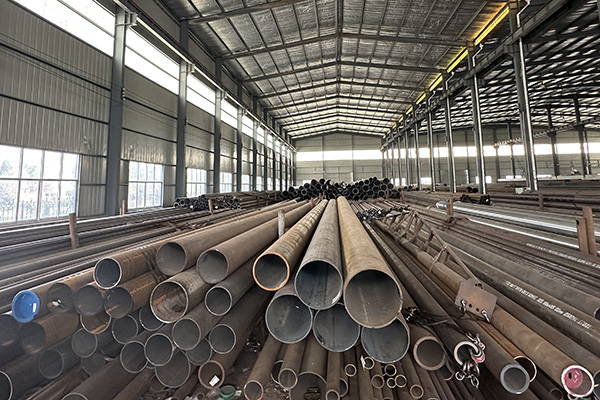
The Chinese standard GB/T 5310 covers seamless steel tubes and pipes for high pressure boilers and is widely specified across power generation, petrochemical and industrial boiler projects in Asia, the Middle East and increasingly in export markets where Chinese boiler technology is installed. Its grades map closely to international equivalents, which simplifies specification for mixed-standard projects.
Main Grades and Their Service Envelopes
Selecting the correct GB/T 5310 grade is primarily a question of metal temperature:
20G - carbon manganese steel for boiler service, comparable to ASTM A210 Grade C and DIN 17175 St45.8. Suitable for waterwalls, economisers and lower temperature evaporator circuits, typically up to about 450 C
15CrMoG - 1Cr-0.5Mo alloy, comparable to ASTM A335 P11 / A213 T11 and DIN 17175 13CrMo44. Used for superheaters, reheaters and headers with metal temperatures up to roughly 550 C
12Cr1MoVG - Cr-Mo-V alloy with improved creep strength, comparable in application to ASTM A335 P12 and approaching P22 performance. Common in high temperature superheater and main steam piping up to approximately 570-580 C
12Cr2MoG / 12Cr2MoWVTiB - higher alloy grades used where design temperature approaches or exceeds 600 C
Grade selection must be based on calculated metal temperature rather than steam temperature, since tube walls run considerably hotter than the fluid inside them.
Metallurgical Advantages of the Alloy Grades
The addition of chromium provides steam oxidation resistance, molybdenum contributes creep strength, and vanadium in 12Cr1MoVG refines the carbide distribution and stabilises strength at elevated temperature. The resulting benefits include:
Higher allowable stress at temperature, permitting thinner walls and lower thermal mass
Improved resistance to steam-side oxide scale formation and exfoliation
Better microstructural stability over long service exposure
Reliable performance under load cycling in plants that operate flexibly
Heat Treatment and Fabrication
GB/T 5310 alloy grades are supplied in the normalised and tempered condition, with normalising typically in the 900-980 C range depending on grade, followed by tempering above 680 C. This produces a stable ferrite-bainite or tempered bainite structure suitable for long-term creep service.
Fabrication requirements mirror those for equivalent ASTM grades: controlled preheat, matching consumables, restricted interpass temperature and mandatory post-weld heat treatment. Cold bending is generally discouraged; hot forming should be followed by full re-normalising and tempering to restore specified properties.
Typical Applications
Superheater, reheater and platen tubes in utility and industrial boilers
High pressure headers, steam piping and connecting tubes
Main steam and hot reheat piping in subcritical and supercritical power units
Process boilers and waste heat recovery systems in chemical, metallurgical and cement plants
High temperature heat exchangers operating under pressure
Manufacturing and Quality Control
A qualified high pressure boiler tube supplier applies rigorous stage control:
Billet verification with full spectrographic chemistry
Hot piercing, rolling and sizing, followed by cold finishing where tighter tolerance is required
Normalising and tempering in calibrated furnaces with continuous chart recording
Dimensional inspection of OD, wall thickness, ovality, length and straightness
Hydrostatic testing or non-destructive electric testing on each length
Mechanical testing - tensile, impact, hardness, flattening and flaring
Microstructural examination and grain size verification where specified
Traceability, marking and EN 10204 3.1 / 3.2 documentation
Positive material identification (PMI) is strongly recommended at receipt, since alloy grade mix-up in boiler service is a well-documented cause of premature failure.
Conclusion
Long-term boiler reliability depends on matching material capability to metal temperature, and then verifying that the delivered pipe actually meets the specification. GB/T 5310 seamless steel pipe in 20G, 15CrMoG and 12Cr1MoVG covers the full band from waterwall service to high temperature main steam, with heat treatment and testing regimes designed for creep service. Sourcing from an experienced China high pressure boiler pipe manufacturer with documented heat treatment, full mechanical testing and third-party inspection support provides the assurance that critical boiler circuits require.
Andrew Bennett
Power Plant Materials Specialist, Baoyang Pipeline
Andrew Bennett is a power plant materials specialist at Cangzhou Baoyang Pipeline Equipment Co., Ltd. with seventeen years of experience in boiler and steam system engineering. He supports utility and industrial clients with GB/T 5310 grade selection, heat treatment verification and quality documentation for high pressure boiler piping.