

In the demanding environment of refineries, thermal power stations and petrochemical complexes, high temperature process piping operates continuously at the edge of its material envelope. Selecting a ASTM A106 Grade B seamless carbon steel pipe is rarely about finding the cheapest line; it is about guaranteeing that pipe carrying steam, hydrocarbon or hot water at elevated temperature will not creep, thin or rupture over decades of thermal cycling. Procurement teams who understand this specification consistently make better long-term decisions than those who buy on price alone.
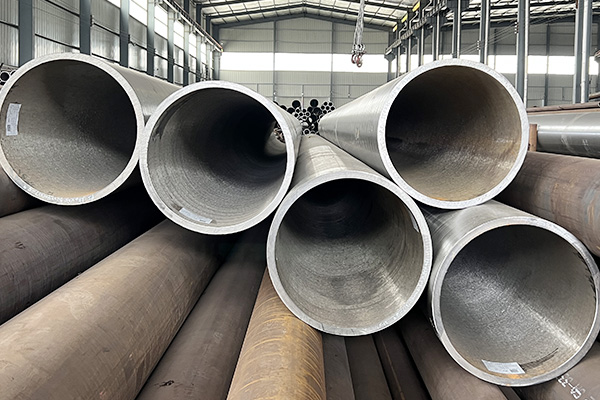
Global industrial operators continue to push plants toward higher efficiency, which means higher steam parameters and higher process temperatures. The shift toward stricter safety standards and tighter environmental compliance has also reduced tolerance for leaks and unplanned outages. In this context, a well-understood, widely stocked specification such as ASTM A106 Grade B remains remarkably competitive.
What ASTM A106 Grade B Covers
ASTM A106 / ASME SA106 is the standard specification for seamless carbon steel pipe for high temperature service. It is available in three grades - A, B and C - with Grade B being by far the most commonly specified. Typical Grade B requirements include:
Mechanical properties - minimum tensile strength of 415 MPa and minimum yield strength of 240 MPa
Chemistry limits - controlled carbon, manganese, phosphorus, sulphur and silicon to support weldability and elevated temperature performance
Manufacturing route - seamless, by hot finishing or cold drawing
Mandatory testing - hydrostatic testing of each length, flattening, bending and tensile testing
Supplementary requirements - ultrasonic examination, non-destructive electric testing, and Charpy impact testing where specified
Grade B is normally used for process piping under ASME B31.1 and B31.3, and is routinely paired with matching A105 flanges, A234 WPB fittings and A193 B7 bolting, giving engineers a fully compatible material set.
Temperature Performance and Design Limits
Carbon steel loses strength as temperature rises, and above roughly 425 C graphitisation becomes a genuine long-term concern while above about 450 C creep governs design. ASTM A106 Grade B is therefore typically applied in the range from ambient up to approximately 400-425 C, with design stress values taken from ASME Section II Part D. Above that threshold, alloy grades such as ASTM A335 P11, P22, P91 or P92 become the appropriate selection.
Practical design also has to account for thermal expansion. Proper support spacing, expansion loops and flexibility analysis prevent fatigue cracking at nozzle connections, which is one of the most common causes of unplanned repair in high temperature systems.
Typical Applications
Refinery process piping carrying hot hydrocarbon streams
Boiler feedwater, steam condensate and auxiliary steam lines in thermal power plants
Petrochemical and chemical plant utility and process headers
High pressure water and fire protection systems
Heat exchanger and condenser piping services
General industrial fluid transport where elevated temperature and pressure coincide
Advantages Over Welded Alternatives
The seamless manufacturing route removes the longitudinal weld seam, which is statistically the weakest location in a pipe under pressure cycling. Additional advantages include:
Uniform mechanical properties around the full circumference
More predictable behaviour under bending, flanging and threading operations
Reduced inspection scope - no seam to examine ultrasonically along the full length
Better wall thickness consistency supporting accurate flow and stress calculations
Wider availability in heavy wall schedules such as SCH 80, SCH 120 and SCH 160
Manufacturing and Quality Control
A professional carbon steel seamless pipe manufacturer applies stage-by-stage control:
Billet inspection and spectrographic verification of chemistry
Hot piercing and rolling, or cold drawing for tighter dimensional tolerance
Heat treatment where required, with furnace chart records
Hydrostatic testing of every length at the specified pressure
Non-destructive testing - ultrasonic, eddy current or magnetic particle as specified
Dimensional verification of outside diameter, wall thickness, length and straightness
End finishing - plain, bevelled or threaded with coupling - and protective coating or varnish
Batch traceability with engraved heat numbers and EN 10204 3.1 / 3.2 certification
Export projects routinely add third-party inspection and, for sour service, NACE MR0175 / ISO 15156 compliance. Both should be accommodated by the mill without disrupting delivery schedules.
Specifying and Sourcing
When ordering ASTM A106 Grade B pipe, clarity at specification stage prevents costly rework later. Items to define explicitly include nominal pipe size and schedule, length (fixed or random), end finish, hydrostatic test pressure, heat treatment condition, supplementary NDT requirements, coating, marking and documentation level. Confirming whether seamless or welded construction is acceptable for the service is also essential, since A53 and A106 are sometimes mistakenly interchanged.
Conclusion
Few specifications have earned their position as thoroughly as ASTM A106 Grade B seamless carbon steel pipe. It offers a proven combination of elevated temperature strength, weldability, availability and cost efficiency across refinery, power and chemical service. Sourcing from an established ASTM A106 Gr.B supplier that maintains stock in common schedules, provides certified mill documentation and supports third-party inspection is the most direct way to keep high temperature piping projects on schedule and within specification.
Christopher Lee
Process Piping Specialist, Baoyang Pipeline
Christopher Lee is a process piping specialist at Cangzhou Baoyang Pipeline Equipment Co., Ltd. with fourteen years of experience serving refinery, power and petrochemical clients. He works with design institutes and procurement teams on material specification, wall thickness calculation and third-party inspection for high temperature carbon steel piping systems.