

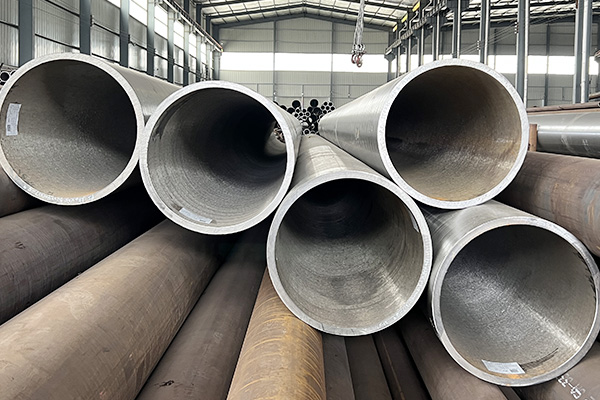
In the demanding world of industrial steam distribution, the pipeline is expected to carry saturated or superheated steam at elevated pressure and temperature for decades while remaining leak-tight. Steam combines thermal stress, pressure stress and corrosion risk in a way that few other media do, and a failure in a steam main is rarely a small event. This is why API 5L X42 and X46 steam pipeline tube has become a standard selection for high pressure steam transport across power generation, refining and district heating.
Global industry continues to depend on steam for process heat, turbine drive and heating networks, and operators increasingly run systems at higher parameters to improve efficiency. That trend tightens the requirements placed on every metre of steam main.
Why X42 and X46 Are the Common Steam Grades
API 5L grades X42 and X46 specify minimum yield strengths of 290 MPa and 320 MPa respectively. Within the API 5L family they sit in the lower-to-middle strength band, which is precisely why they suit steam service:
Adequate pressure capability for the majority of industrial and district steam mains
Excellent weldability thanks to moderate carbon equivalent, simplifying field girth welding and branch connections
Good toughness and ductility, which accommodates thermal expansion stresses
Wide availability in the wall thickness schedules steam service typically requires
Cost efficiency compared with X60 or X70, where the extra strength is not needed
The X46N designation indicates normalised delivery, which refines grain structure and improves toughness - a useful specification for steam mains subject to thermal cycling.
Thermal Expansion: The Governing Design Issue
Steam mains expand substantially between ambient and operating temperature. A carbon steel line running at 300 C expands roughly 4 mm per metre from its installed length. Unmanaged, that movement generates forces that crack nozzles, distort supports and shear branch connections.
Practical mitigation includes:
Proper flexibility analysis of the full line, including anchors and guides
Expansion loops, offsets or bellows units sized for the calculated movement
Correct support spacing and the use of sliding or spring supports where vertical movement occurs
Controlled warm-up rates to avoid differential expansion during start-up
Drainage provisions at low points to prevent condensate accumulation and water hammer
Insulation and Corrosion Considerations
Steam piping is almost always insulated, and the insulation system is where many long-term problems originate. Key requirements include:
Insulation thickness matched to the thermal specification, with a continuous vapour barrier
Correct installation of the external cladding to prevent water ingress
Corrosion under insulation (CUI) protection, typically a high temperature coating applied before insulation
External coating on buried sections - commonly 3PE or FBE - combined with cathodic protection where soil conditions require it
Corrosion under insulation is one of the most expensive degradation mechanisms in steam systems because it is invisible until significant wall loss has occurred. Specifying coating and inspection access at design stage is far cheaper than retrofitting it later.
Typical Applications
Main and auxiliary steam lines in thermal power plants
Process steam distribution in refineries and petrochemical complexes
District heating and long-distance thermal steam transmission networks
Steam headers and distribution mains in pulp, paper, textile and food plants
Condensate return lines operating at elevated temperature
Manufacturing and Quality Control
A reliable steam line pipe supplier applies the following controls:
Raw material verification with mill certification and spectrographic chemistry
Controlled forming and, where specified, normalising heat treatment with recorded furnace charts
Dimensional inspection including outside diameter, wall thickness, ovality and length
Non-destructive testing of the pipe body - ultrasonic or electromagnetic examination
Hydrostatic testing of every length at the specified test pressure
Mechanical testing - tensile, impact where specified, and hardness
End bevelling to the specified angle, coating application, marking and bundling
Full traceability with EN 10204 3.1 or 3.2 documentation
For steam service, buyers should additionally confirm that the specified test pressure exceeds the operating pressure by the margin required by the applicable design code, normally ASME B31.1 for power piping or B31.3 for process piping.
Conclusion
High pressure steam transport rewards conservative material selection and disciplined design. API 5L X42 and X46 steam pipeline tube offers the pressure capability, weldability and toughness that steam mains require, with the availability and cost profile that large networks depend on. Working with an experienced China line pipe manufacturer that supplies certified material, supports full non-destructive testing and maintains production capacity for bulk supply helps operators bring steam systems into service on schedule and keep them there.
Richard Palmer
Piping Systems Engineer, Baoyang Pipeline
Richard Palmer is a piping systems engineer at Cangzhou Baoyang Pipeline Equipment Co., Ltd. with fourteen years of experience in steam distribution and industrial pipeline projects. He supports engineering contractors and plant owners with grade selection, wall thickness verification, insulation coordination and quality documentation for API 5L line pipe supplied to export markets.